NOW OPEN! Florida's newest Isuzu dealership in the Tampa area!

Blog / Conley Truck Center

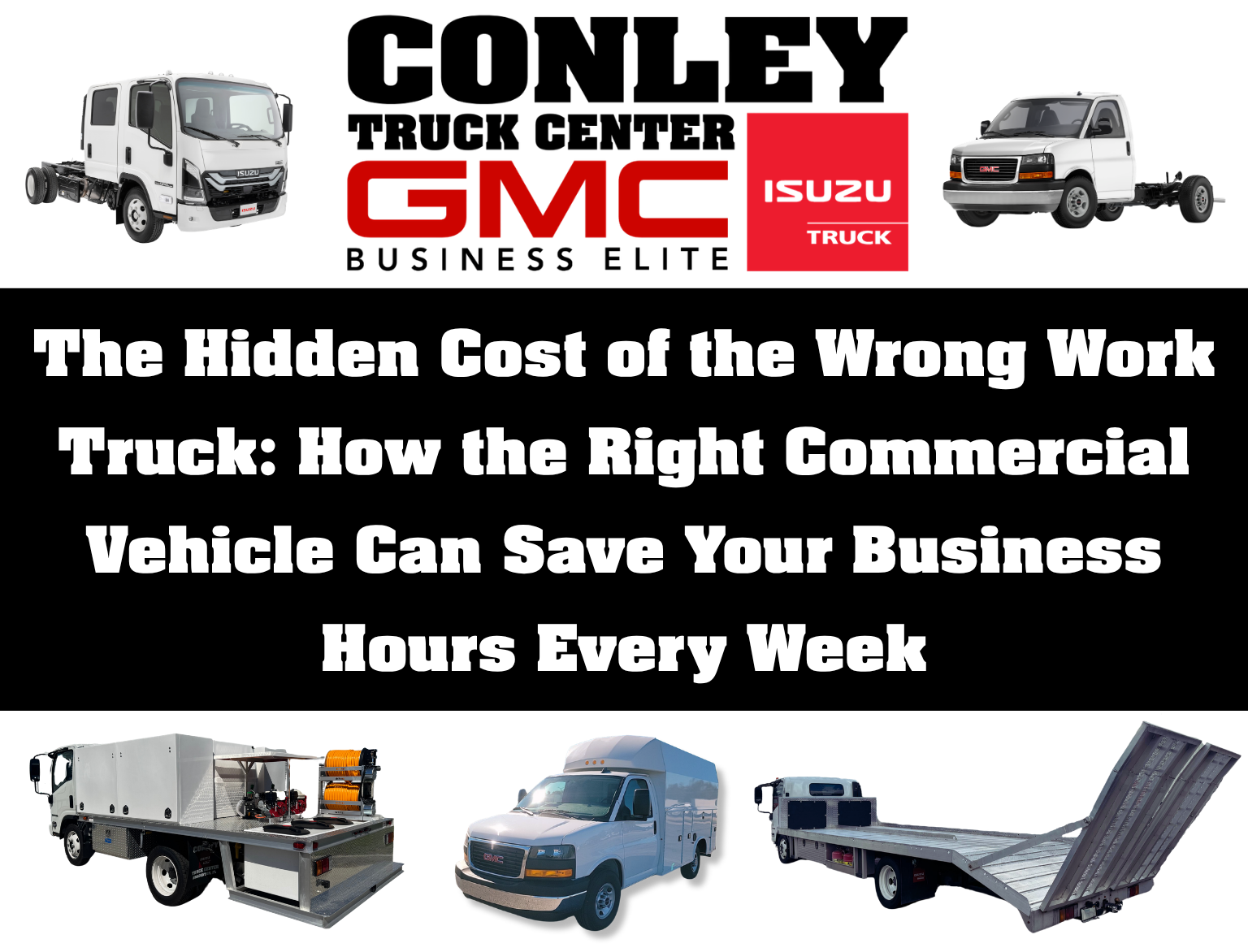
The Hidden Cost of the Wrong Work Truck: How the Right Commercial Vehicle Can Save Your Business Hours Every Week

The Hidden Cost of the Wrong Work Truck: How the Right Commercial Vehicle Can Save Your Business Hours Every Week

For a business owner, a commercial truck isn't simply a vehicle.

It's an employee, a warehouse, a toolbox, a delivery system and, in many cases, one of the most important pieces of equipment the company owns.

That means the true cost of a work truck isn't determined by its purchase price alone.

A truck that is difficult to maneuver can waste time at every stop. A truck without the right body can force employees to load and unload inefficiently. A vehicle that carries too little payload can require additional trips. And a truck that spends too much time waiting for maintenance or repairs isn't producing revenue at all.

For businesses throughout Bradenton, Sarasota, Tampa, Fort Myers and Florida's Gulf Coast, choosing the right commercial truck can have a surprisingly large impact on productivity.

At Conley Truck Center in Bradenton, FL, we help businesses look beyond the obvious specifications and find commercial vehicles designed around the work they actually perform.

Because sometimes the most important specification on a work truck isn't horsepower.

It's time.

Start Thinking in Minutes, Not Just Miles

Imagine two companies performing the same type of work.

Both crews drive roughly the same number of miles each day. Both have similar numbers of employees. Both operate comparable commercial vehicles.

But Company A's truck takes an extra five minutes to park at each job site.

Its equipment isn't organized efficiently, adding another three minutes of loading and unloading.

The truck's configuration also occasionally requires a second trip to transport materials.

None of those problems sound catastrophic individually.

But multiply those lost minutes across five, ten or fifteen stops per day. Then multiply that by five days per week and 50 weeks per year.

Suddenly, a truck that seemed "good enough" may be costing the business hundreds of productive hours.

That's why commercial vehicle selection should start with a different question:

What does this truck need to accomplish every day?

Maneuverability Can Be a Business Advantage

Commercial trucks don't spend their entire lives cruising down open highways.

They back into loading docks.

They navigate apartment complexes.

They squeeze into landscaping job sites.

They make deliveries in crowded shopping centers.

They travel through residential neighborhoods.

And they frequently operate in places that weren't designed with large commercial vehicles in mind.

This is one reason cab-over trucks such as the Isuzu N-Series can make so much sense for commercial applications.

The cab-over design places the driver farther forward than a traditional conventional-cab truck. Combined with Isuzu's focus on maneuverability, this can make navigating confined working environments easier.

Conley Truck Center offers Isuzu models suited to a wide variety of commercial applications, including trucks such as the NPR-HD, NPR-XD, NQR and NRR.

For businesses making dozens of stops every day, maneuverability isn't simply about driver convenience.

It can become a productivity tool.

Saving even a small amount of time at each stop can add up significantly across an entire fleet.

The Truck Body May Matter More Than the Truck

One of the biggest mistakes businesses can make is shopping for a commercial truck the same way they shop for a personal vehicle.

With a personal vehicle, choosing the model is usually the majority of the decision.

With a commercial vehicle, it's only the beginning.

The body and equipment installed behind the cab determine what that truck can actually accomplish.

A landscaping company may need a landscape dump body.

A delivery operation might need a large dry-freight box.

A contractor could benefit from organized service-body storage.

A municipality might require a dump configuration.

A refrigerated delivery business needs an entirely different setup.

That's why commercial trucks are better viewed as platforms for building specialized business tools.

The chassis provides the foundation. The body transforms it into something capable of performing a specific job.

Conley Truck Center works with commercial vehicles and upfit configurations designed for industries including landscaping, construction, delivery, HVAC, plumbing, logistics, municipalities and other professional applications.

The goal shouldn't be to simply buy a truck.

It should be to build the right tool.

Payload Changes the Productivity Equation

Payload is another specification that deserves more attention from commercial buyers.

Suppose your crew regularly needs to transport equipment, tools, materials and employees to a job site.

If the truck can't legally and safely accommodate the required load, something has to change.

Maybe another vehicle gets dispatched.

Maybe the crew makes another trip.

Maybe equipment gets left behind.

Every solution creates another expense.

That's why stepping into a higher-GVWR commercial truck can sometimes make financial sense even when a smaller truck initially appears less expensive.

Models such as the Isuzu NRR provide businesses with a versatile Class 5 platform that can support a wide variety of vocational bodies and applications.

For companies with even greater medium-duty requirements, trucks such as the Isuzu FTR provide another step up in capability.

The smartest choice isn't necessarily the biggest truck available.

It's the truck properly matched to the payload and application.

Too little truck can limit productivity.

Too much truck can create unnecessary operating costs.

Finding the sweet spot matters.

Your Employees Work Out of the Truck, Too

There's another factor that's easy to overlook when comparing commercial vehicles:

The driver.

An employee operating a commercial truck may enter and exit the cab dozens of times during a workday.

Delivery drivers, landscapers, contractors and service technicians don't simply drive to work.

Driving is part of the work.

Cab accessibility, visibility, seating position, interior organization and maneuverability can therefore have an impact on the employee's entire day.

Some applications may also require transporting a larger crew. For example, certain Isuzu NPR-HD crew cab configurations provide additional seating behind the front row, allowing businesses to transport employees and equipment together.

Again, the question isn't simply:

"Is this a good truck?"

It's:

"Is this a good truck for the way our employees actually work?"

Downtime Might Be the Most Expensive Specification of All

There's one specification you'll never find printed prominently on a window sticker:

How much money does your company lose when the truck isn't running?

For some businesses, the answer might be hundreds of dollars per day.

For others, it could be thousands.

A commercial vehicle sitting in a parking lot waiting for repairs isn't just inconvenient. It may represent missed deliveries, delayed jobs, idle employees and unhappy customers.

That's why service should be part of the vehicle purchasing decision from the beginning.

Conley Truck Center's Bradenton facility provides dedicated commercial service with factory-trained technicians for Isuzu trucks and commercial vehicles.

Our focus isn't simply repairing trucks.

It's getting businesses back to work.

Conley Truck Center also stocks and sources genuine OEM Isuzu parts, helping customers get the components their trucks need without treating commercial vehicle parts as an afterthought.

Because when your truck generates revenue, uptime matters.

Preventive Maintenance Is Really Productivity Insurance

Business owners sometimes view maintenance exclusively as an expense.

For commercial fleets, it may be more useful to view it as protection against lost productivity.

Oil changes, filters, brakes, tires, fluids and inspections cost money.

An unexpected breakdown during the busiest week of the year can cost significantly more.

Preventive maintenance gives technicians opportunities to identify developing issues before those issues become roadside problems.

It can also help businesses schedule downtime rather than having downtime choose them.

A truck serviced Tuesday morning and returned to work is much easier to plan around than a truck that unexpectedly stops running Friday afternoon with deliveries still on the schedule.

That predictability has real value.

Don't Ignore Pre-Owned Commercial Trucks

Optimizing productivity doesn't necessarily mean purchasing new.

For many businesses, pre-owned commercial trucks can offer an excellent path to expanding capacity while controlling acquisition costs.

Conley Truck Center carries pre-owned commercial and fleet vehicles, including a strong selection of Isuzu trucks and specialized commercial configurations.

Used trucks can be particularly attractive when the vehicle already has the body your operation needs.

Instead of purchasing a chassis and waiting for an upfit to be completed, a business may be able to find a work-ready truck equipped with a box, dump body, service body or another useful configuration.

That can reduce both acquisition costs and the amount of time between purchasing the vehicle and putting it into service.

And for a growing business, getting another revenue-producing truck on the road sooner can make a significant difference.

Calculate the Cost Per Job — Not Just the Monthly Payment

When comparing commercial vehicles, it's natural to focus on purchase price or monthly payment.

But businesses should consider a broader calculation.

Think about:

How many jobs can this truck help us complete each week?

Consider fuel, maintenance and insurance—but also consider payload, cargo capacity, maneuverability, loading time, employee efficiency, reliability and expected downtime.

A truck that costs slightly more but allows a crew to complete an additional job each day could potentially be the less expensive vehicle in the long run.

Likewise, an inexpensive truck that constantly limits the operation may ultimately become very expensive.

The best commercial vehicle isn't always the one with the lowest price.

It's the one that produces the best return for the business.

One Truck Can Change How a Business Operates

The right truck can eliminate an extra trip.

It can allow a company to accept larger jobs.

It can carry an entire crew.

It can organize tools more effectively.

It can simplify deliveries.

It can reach locations that are difficult for larger conventional trucks.

It can replace multiple aging vehicles.

And when properly configured, it can create capabilities a business simply didn't have before.

That's what makes commercial vehicle shopping fundamentally different from ordinary vehicle shopping.

You're not only purchasing transportation.

You're purchasing capacity.

Find the Right Commercial Truck at Conley Truck Center in Bradenton, FL

At Conley Truck Center, we specialize in helping businesses find commercial vehicles that fit the way they actually operate.

Located at 704 Cortez Road West in Bradenton, Florida, Conley Truck Center offers new Isuzu commercial trucks, GMC Business Elite commercial vehicles, pre-owned work trucks, commercial upfits, certified service and genuine commercial truck parts.

Our Isuzu lineup includes versatile commercial platforms such as the NPR-HD, NPR-XD, NQR, NRR and FTR, giving businesses options for a wide range of GVWR requirements, bodies and vocational applications.

We proudly serve commercial customers throughout Bradenton, Sarasota, Lakewood Ranch, Venice, North Port, Tampa, Fort Myers and communities across Florida.

Whether you're buying your company's first commercial vehicle, replacing an aging truck or building an entire fleet, there's one question worth asking before looking at anything else:

How can the right truck help my business accomplish more every day?

Find that answer, and you'll be much closer to finding the right truck.

Conley Truck Center — helping Florida businesses keep moving, one work-ready truck at a time.
Posted in:

Related Posts

How to Protect the Resale Value of Your Commercial Truck: 10 Things Business Owners Should Do

How to Protect the Resale Value of Your Commercial Truck: 10 Things Business Owners Should Do

A commercial truck is supposed to make money. But eventually, there's another number that matters: What is it worth when you're finished with it? For businesses, resale value can easily become an afterthought. You buy a truck. Put it to work. Load it with equipment. Rack up miles. Service it. Modify it. Maybe add a box, dump body, liftgate, service body or another specialized upfit. Then, five or eight years later, you decide it's time to sell or trade it. That's when all the decisions made during those years come back into the picture. At Conley Truck Center in Bradenton, Florida, we don't only sell new and pre-owned commercial vehicles. We also buy trucks, including vehicles with commercial modifications and upfits. And when it comes time to evaluate a commercial truck, mileage is only one part of the story. If you operate one work truck or an entire fleet, here are 10 things you can do throughout ownership to help protect your investment. 1. Treat Maintenance Records Like They Have a Dollar Value Because someday, they might. Imagine you're looking at two nearly identical used commercial trucks. Same year. Same model. Similar mileage. Similar body. Truck A comes with a detailed maintenance history showing regular service throughout its working life. Truck B comes with: "We took pretty good care of it." Which truck gives you more confidence? Documentation matters. Commercial vehicles work hard, and a clear maintenance history helps tell the next owner—or dealership evaluating the vehicle—how it was treated. Keep records of things like: Oil and filter changes Brake service Tire replacements Fluid services Cooling-system maintenance Transmission service Repairs Inspections Recall work Major component replacements If you operate a fleet, consider keeping a dedicated file for every vehicle from the day it enters service. That record can help with maintenance planning today and become useful documentation when it's time to sell tomorrow. 2. Don't Confuse "Still Running" With "Well Maintained" Commercial trucks are tough. That's why businesses buy them. But durability can occasionally encourage a dangerous attitude: "It's still running, so we'll deal with it later." Later has a habit of becoming expensive. A small issue that could have been addressed during routine maintenance may develop into a larger repair. Meanwhile, deferred maintenance can create a pattern that's visible when the truck is eventually inspected. Maintaining a work truck isn't only about preventing breakdowns. It's also about protecting the asset itself. At Conley Truck Center, the service department works with commercial customers because downtime represents real lost opportunity and revenue for a business. The dealership's current site says factory-trained technicians diagnose and repair commercial vehicles and that most repairs receive a 24-hour turnaround. Keeping up with service throughout ownership can help the truck remain productive today while protecting its condition for tomorrow. 3. Remember That Buyers Inspect the Body Too This is where commercial vehicles are completely different from ordinary cars. With a passenger vehicle, most people think about: Engine. Transmission. Interior. Paint. Tires. Mileage. With a commercial truck, there's another major component: The thing attached behind the cab. A box truck with a damaged box isn't simply a truck with cosmetic wear. A dump truck with a poorly functioning hoist isn't simply an older vehicle. A liftgate that doesn't operate correctly can affect the usefulness of the entire truck. The same goes for: Service bodies. Flatbeds. Landscape bodies. Stake bodies. Tool compartments. Refrigerated bodies. Shelving. Cargo equipment. Commercial buyers are purchasing a complete business tool. That means the condition of the upfit can influence how desirable that vehicle is. 4. Take Care of the Upfit Like You Take Care of the Chassis This deserves its own section. Imagine you've invested thousands of dollars into turning a commercial chassis into exactly the truck your business needs. Then the upfit receives virtually no maintenance for five years. That doesn't make much sense. Moving components should operate properly. Doors should close correctly. Locks should work. Storage compartments should remain usable. Hydraulic systems should receive appropriate attention. Liftgates should be inspected and maintained according to their requirements. Rust or corrosion should be addressed. Electrical accessories should function. A good commercial body can add tremendous usefulness to a truck. Maintaining that body helps preserve that usefulness. Conley Truck Center currently works with commercial upfit manufacturers including Knapheide, Reading, Monroe, Royal, Supreme, Rockport, CM Truck Beds, Adrian Steel, Masterack, Wabash, Norstar and PJ Truck Beds, illustrating just how many different directions a commercial chassis can go depending on the business. Your upfit is part of your investment. Treat it that way. 5. Choose the Right Upfit in the First Place Here's something interesting: Protecting resale value can actually begin before you buy the truck. Some commercial configurations have extremely broad usefulness. A box truck can appeal to: Delivery companies. Moving businesses. Furniture companies. Logistics operations. Retail businesses. Contractors. Other configurations may serve much narrower applications. That doesn't mean you should avoid a specialized upfit. If a specialized truck makes your business substantially more productive, that's exactly what you should buy. But businesses should understand the tradeoff. The more specialized the truck becomes, the more specialized its potential future buyer may be. That's another reason to work with people who understand commercial vehicles when choosing a chassis and body combination. You're not simply building today's truck. You're creating an asset that may eventually have another owner. 6. Don't Ignore the Cab Work trucks get dirty. Nobody expects a five-year-old commercial vehicle to look like it spent its entire life inside a museum. But there's a big difference between normal commercial wear and neglect. Seats. Dashboard. Flooring. Door panels. Headliner. Controls. Storage areas. Employees interact with these surfaces every day. Small habits can make a difference over several years. Use appropriate floor protection. Clean spills. Repair damaged upholstery before it gets significantly worse. Avoid letting the cab become permanent storage for trash and unused equipment. And periodically give the interior a real cleaning. The cab doesn't need to be flawless. It should look like the business cared about its equipment. 7. Don't Let Small Exterior Damage Become Big Exterior Damage Work trucks encounter things passenger vehicles rarely do. Job sites. Branches. Loading docks. Equipment. Forklifts. Tools. Loose materials. Tight parking areas. Minor damage happens. But ignoring damage can create additional problems. A small exposed area of metal may eventually develop corrosion. A damaged door or compartment can worsen. A loose piece of body hardware can create more wear. Again, perfection isn't realistic. Commercial trucks are supposed to work. The goal is simply to prevent minor issues from becoming major ones. There's a difference between a truck that has been used and a truck that has been neglected. Future buyers can usually see it. 8. Be Smart About Modifications Modifications can add enormous value to a work truck. They can also make the vehicle harder to sell if they're poorly executed. There's a difference between a professionally installed commercial upfit and improvised modifications that future owners have to undo. Think carefully before: Drilling unnecessary holes. Making permanent alterations. Changing wiring. Adding equipment without considering the electrical system. Welding or modifying structural components. Removing factory equipment. A modification should make the truck better at its job without unnecessarily compromising the underlying vehicle. And whenever possible, keep documentation for professionally installed equipment. Conley Truck Center specifically notes that when evaluating trucks it buys, its team considers factors including mileage, overall condition, modifications and market demand—and has experience assessing the added value of commercial upfits. That makes professional, useful modifications very different from random alterations. 9. Mileage Matters — But So Does What Happened During Those Miles Two commercial trucks can show 100,000 miles and have lived completely different lives. Truck A spent most of those miles cruising on highways. Truck B spent years making dozens of short deliveries every day. Stopping. Starting. Idling. Loading. Unloading. Backing. Maneuvering through job sites. The odometers may match. The duty cycles don't. That's why maintenance history and overall condition are so important. Mileage provides context. It doesn't tell the entire story. This is also why a higher-mileage truck with an excellent history can sometimes be more appealing than a lower-mileage truck with obvious signs of neglect. Buyers aren't purchasing the number on the dashboard. They're purchasing the truck attached to it. 10. Know When It's Time to Sell This may be the hardest part. Business owners often fall into one of two camps. The first replaces vehicles extremely early. The second keeps them until the tow truck becomes a member of the staff. There's a middle ground. Every commercial vehicle has a period where it provides excellent productive value. Eventually, maintenance expenses may increase. Downtime may become more frequent. Business requirements may change. Or newer equipment may simply be better suited to the operation. The goal isn't necessarily to squeeze every possible mile out of a truck. It's to maximize its business value. Sometimes selling a truck while it still has meaningful useful life can provide capital toward the next vehicle. Waiting until it needs substantial repairs, has serious cosmetic problems and no longer performs reliably may reduce your options. Think About Resale Before Your Business Outgrows the Truck There's another reason companies sell commercial vehicles: The truck is perfectly fine. The business simply changed. Maybe you started with local deliveries and now need a larger box. Maybe your landscaping company added another crew. Maybe you need a crew cab. Maybe payload requirements increased. Maybe your business no longer performs the type of work the truck was built for. Maybe you need to move from a lighter truck into something like an Isuzu NRR or FTR. That's normal. Business equipment should evolve with the business. A truck doesn't have to be worn out to be worth replacing. Sometimes it simply needs a different job—and another business may be looking for exactly what you have. Why Isuzu Trucks Can Make Sense as Long-Term Business Assets One reason commercial buyers consider Isuzu trucks is that they're designed specifically around business applications. Conley Truck Center's current Isuzu lineup includes trucks such as the NPR-HD, NPR-XD, NQR, NRR and FTR. The site's current vehicle information highlights qualities such as maneuverability, durability and multiple vocational applications across the lineup. The cab-over configuration also allows these chassis to be paired with a wide variety of commercial bodies. That versatility matters throughout ownership. A well-maintained chassis paired with a useful commercial body can remain a productive piece of equipment for a long time. And when you're finished with it, another company may be able to put that same configuration to work. A Good Example: The Landscape Dump Truck Consider a landscape truck. Conley Truck Center currently offers Isuzu chassis equipped with specialized landscape dump bodies designed for landscaping, construction and municipal applications. One current NPR-HD configuration uses a 14-foot aluminum landscape dump body with features including tool storage, side-loading capability, a tarp system and dedicated shovel storage. That's much more than transportation. It's a specialized business tool. If properly maintained, the useful value of that vehicle extends beyond the engine and chassis. Another landscaper or contractor may specifically want those features. That's why commercial truck resale is different from selling an ordinary used vehicle. The right upfit can matter. Crew Cab Trucks Can Have Another Advantage Crew cab commercial trucks are another interesting example. Conley currently lists an Isuzu NRR Gas Crew Cab capable of seating up to seven people and supporting several vocational configurations. Think about who might find that useful. Landscaping companies. Construction crews. Municipalities. Service companies. Businesses that need to move employees and equipment together. When it's time to sell, you're not simply offering "a used truck." You're potentially offering another company a ready-made solution to a specific operational problem. That's why maintaining both the vehicle and its equipment matters. Should You Remove Your Company's Branding Before Selling? Usually, yes. Commercial trucks often become moving billboards. Company logos. Phone numbers. Websites. DOT information. Unit numbers. Wraps. Lettering. Before selling or trading a truck, remove business-specific branding appropriately. This isn't only about appearance. You probably don't want a vehicle carrying your company's name after it belongs to somebody else. If the truck has been fully wrapped, professional removal is generally preferable to aggressively attacking the vinyl yourself and potentially damaging the finish underneath. Planning ahead matters here, too. A well-installed and properly maintained wrap may have protected portions of the paint during ownership. But removal should be handled carefully. Clean the Truck Before You Have It Evaluated This sounds almost too obvious. But commercial vehicles are busy. Sometimes owners bring them in exactly as they finished Friday's job. Tools everywhere. Trash inside. Materials in the body. Mud. Debris. Receipts from 2023. Give the truck a chance to present itself properly. Wash it. Clean the cab. Empty unnecessary equipment. Organize whatever stays. Make sure the body is accessible for inspection. Gather service records. Find spare keys. Bring documentation for significant upfits or equipment if available. You're trying to make the evaluator's job easier. That's rarely a bad strategy. Should You Repair Everything Before Selling? Not necessarily. This is where people can waste money. Suppose a truck needs $5,000 worth of work. Will spending that $5,000 increase its sale value by more than $5,000? Maybe. Maybe not. Minor inexpensive fixes can make sense. A missing piece of trim. A burned-out bulb. A simple maintenance item. An easily repaired latch. But major repairs deserve a more careful calculation. Before putting substantial money into a truck you're planning to sell anyway, find out what it's worth in its current condition. The numbers may surprise you. Selling a Commercial Truck Is Different From Selling a Car Selling a personal vehicle privately is relatively straightforward. Commercial trucks introduce additional variables. Body configuration. GVWR. Wheelbase. Equipment. Upfit manufacturer. Liftgate. Cab configuration. Commercial use. Specialized accessories. Maintenance history. Business buyers may ask questions that ordinary used-car shoppers never would. That's one reason working with a commercial truck dealership can simplify the process. The people evaluating the vehicle understand what they're looking at. Conley Truck Center Buys Trucks, Too At Conley Truck Center in Bradenton, Florida, we're always interested in commercial trucks. Conley's truck-buying program accepts vehicles across makes, models and mileage ranges, whether you're trading toward another vehicle or simply looking to sell. Our team evaluates factors including: Mileage Overall condition Modifications Upfits Market demand That last part is important. A specialized commercial truck shouldn't necessarily be evaluated like an ordinary pickup. The equipment attached to it may have real business value. Sell One Truck and Upgrade to the Next Selling a commercial truck can also become part of a larger fleet strategy. Maybe you're moving from a standard cab to a crew cab. Maybe you need more GVWR. Maybe you're replacing an aging box truck. Maybe you're switching from a pickup-and-trailer combination to a dedicated landscape truck. Maybe you're adding an Isuzu NPR-HD, NPR-XD, NQR, NRR or FTR. Maybe your company needs a GMC commercial vehicle instead. Selling or trading existing equipment can help offset the cost of putting the next truck to work. And that's ultimately what matters. Commercial vehicles aren't trophies. They're tools. The objective is to have the right tool earning money for the business. Maintain Today With Tomorrow in Mind You don't need to baby a commercial truck. That's not what it was built for. Put it to work. Haul with it. Deliver with it. Build with it. Landscape with it. Use it to make your business money. But take care of it while you do. Maintain the chassis. Maintain the body. Keep records. Fix problems before they become larger. Use quality parts. Be thoughtful about modifications. And periodically evaluate whether the vehicle still fits your operation. Do those things and you're not only helping the truck perform better today. You're protecting the asset you'll eventually sell tomorrow. Buy, Service and Sell Commercial Trucks at Conley Truck Center in Bradenton, FL Located at 704 Cortez Road West in Bradenton, Florida, Conley Truck Center supports businesses throughout the entire commercial vehicle ownership cycle. We offer: New Isuzu commercial trucks GMC commercial vehicles Pre-owned work trucks Work-ready trucks Commercial upfits Fleet maintenance Isuzu and GMC parts Mobile fleet service Commercial truck purchasing and trade-ins Conley Truck Center serves businesses throughout Bradenton, Sarasota, Lakewood Ranch, Venice, North Port and Florida's Gulf Coast, while also working with commercial customers across the state. Whether you're purchasing your first work truck, maintaining an existing fleet or deciding it's finally time to sell one, think about the entire life of the vehicle. Because the best commercial truck doesn't only make money while you own it. A well-maintained one can still return value to your business on the day you let it go.

Repair or Replace Your Work Truck? 10 Signs It May Be Time to Move On

Repair or Replace Your Work Truck? 10 Signs It May Be Time to Move On

Every work truck eventually has that repair. Maybe it's expensive. Maybe it's unexpected. Maybe it happens at exactly the wrong time. And once the estimate arrives, every business owner eventually asks the same question: Do we fix this truck again—or is it finally time to replace it? That's a much harder question for a commercial vehicle than it is for a personal car. A work truck isn't simply transportation. It's part of the business. It may carry employees, tools, inventory, equipment or materials. It may make deliveries. It may tow. It may be responsible for completing jobs that generate thousands of dollars in revenue. That means replacing a commercial truck too early can waste money. But keeping one too long can be even more expensive. At Conley Truck Center in Bradenton, Florida, we work with businesses ranging from single-truck operators to growing fleets, and one thing is clear: The right time to replace a work truck isn't determined by mileage alone. It's determined by what that truck is costing your business. Here are 10 signs it may be time to stop repairing and start shopping. 1. The Repair Bills Aren't the Biggest Expense Anymore Most owners look at the repair invoice first. $800. $2,000. $5,000. It's understandable. That's the number sitting directly in front of you. But commercial vehicle downtime has another cost that may never appear on an invoice. Suppose a truck spends three days in the shop. What happened during those three days? Did employees sit idle? Did you rent another vehicle? Did deliveries get delayed? Did another truck have to pick up the workload? Did employees make extra trips? Did you turn down a job? Did customers wait longer? That's the difference between repair cost and business cost. A repair may cost $2,000. The disruption surrounding it could cost considerably more. When deciding whether to repair or replace a truck, look at both numbers. 2. Breakdowns Are Becoming a Pattern One repair doesn't necessarily mean a truck is finished. Commercial vehicles are machines, and machines occasionally need repairs. The bigger warning sign is frequency. If the truck seems to need attention every few weeks or months, there's a different problem. Maybe you repair the cooling system this month. Then something electrical fails. Then a suspension component needs replacement. Then another issue appears. Individually, none of those repairs may justify replacing the truck. Together? They start telling a story. At some point, the question becomes less about fixing the latest problem and more about whether you still trust the truck to show up tomorrow morning. For a business vehicle, reliability has financial value. 3. You No Longer Trust the Truck With Your Most Important Jobs This is one of the clearest signs. Imagine your biggest customer calls. They have an important job tomorrow. Which truck do you send? If there's one vehicle in the fleet that everyone quietly avoids assigning to critical work, pay attention. You probably already know why. Maybe someone says: "Don't send that one too far." Or: "Keep it local." Or: "Make sure someone has jumper cables." Or the classic: "It's been fine lately." That last word is doing a lot of work. A commercial vehicle needs to inspire confidence. If your operation is constantly making backup plans around one particular truck, that vehicle may already be costing the business more than it appears. 4. Maintenance Is Getting Harder to Schedule Preventive maintenance is predictable. Unexpected repairs aren't. And predictability is extremely valuable in business. You can schedule an oil change. You can plan around tires. You can arrange routine inspections. You can organize your fleet so one vehicle is serviced while the others remain productive. An unexpected breakdown doesn't care about your schedule. It happens Tuesday morning while the truck is loaded. Or Friday afternoon when your crew has three jobs remaining. Or during your busiest month. As commercial trucks age, businesses should look at whether maintenance remains manageable or whether unscheduled repairs are beginning to control the calendar. There's a major operational difference between: "Truck 4 is going in for service Thursday." and: "Truck 4 isn't starting. What do we do?" 5. You're Spending Money Just to Keep the Truck Doing a Job It Has Outgrown Sometimes the problem isn't age. It's the business. Companies evolve. A landscaping company buys a truck when it has one crew. Five years later, that same company is doing larger commercial properties and carrying far more equipment. A delivery business starts with small local routes. Then customer volume doubles. A contractor takes on bigger jobs. An HVAC company adds technicians. A truck that was perfectly matched to the business when purchased may eventually become too small, too light or simply wrong for the operation. At that point, spending money to keep it running doesn't solve the larger problem. You're repairing a truck that no longer fits the job. That changes the replacement equation dramatically. 6. The Truck Requires Too Many Extra Trips Here's an expense that's easy to miss because it doesn't show up under "repairs." Suppose your existing truck can't carry everything the crew needs. So someone makes another trip. It happens occasionally. No big deal. Then it happens twice a week. Calculate it. Extra fuel. Extra miles. Employee time. Vehicle wear. Potential tolls. Lost productive hours. Now multiply that across an entire year. Suddenly, upgrading to a truck with more appropriate cargo capacity, payload or body configuration doesn't look like an unnecessary expense. It may look like an efficiency investment. A vehicle doesn't have to physically break down to become too expensive. Sometimes the problem is what it forces the business to do around it. 7. The Upfit No Longer Works for Your Operation This is one of the biggest differences between a personal vehicle and a commercial truck. With a work truck, the chassis is only part of the equation. The body matters just as much. A box truck may still run perfectly but have the wrong box size. A service truck may not have enough storage. A landscaping company may need a dump body that its existing vehicle doesn't have. A delivery operation may now need a liftgate. A growing crew may benefit from additional seating. You could continue maintaining the existing vehicle indefinitely and still never solve the operational problem. That's why businesses shouldn't only ask: "Is the truck still mechanically good?" They should also ask: "Is this still the right tool?" Those are two very different questions. 8. Your Crew Is Losing Time Because of the Vehicle Ask the people who use the truck. They may notice problems long before an accounting spreadsheet does. Does loading take too long? Is equipment constantly being rearranged? Is getting in and out difficult? Does the driver struggle to maneuver the vehicle at common job sites? Is the cargo area poorly organized? Do employees regularly need a second vehicle? Does the crew have to unload half the truck to reach one piece of equipment? Those little inefficiencies matter. Suppose an inefficient truck setup wastes 15 minutes per employee each day. That doesn't sound dramatic. But across several employees, five days per week and an entire year, you're talking about a substantial amount of paid labor. The truck may still run perfectly. It just may not work efficiently anymore. 9. You Keep Repairing the Same System One repair is normal. Repeated problems with the same area deserve attention. Sometimes the issue can be permanently corrected. Other times, the vehicle reaches a stage where one repair seems to reveal the next weak link. This is where having an experienced commercial service department matters. A good technician can help you understand whether you're dealing with an isolated repair or a broader aging-vehicle pattern. At Conley Truck Center, our commercial service operation in Bradenton supports Isuzu and commercial-truck customers with factory-trained and ASE-certified technicians, along with access to genuine Isuzu parts. The goal shouldn't be to automatically replace an older truck. The goal should be to make an informed decision. Sometimes repairing it makes perfect sense. Sometimes the smarter answer is moving on. 10. You're Keeping the Truck Only Because It's Paid Off This one deserves some thought. A paid-off truck feels free. No monthly payment. No acquisition expense. It's easy to look at that and assume keeping the truck is automatically the cheapest choice. But a vehicle payment and vehicle cost aren't the same thing. An older paid-off truck still consumes: Fuel. Maintenance. Tires. Parts. Labor. Insurance. Employee time. Downtime. And eventually repairs. The question isn't: "Do we have a payment?" It's: "What does this truck cost us per month to operate?" A paid-off vehicle requiring constant repairs may cost more than a newer vehicle with predictable operating expenses. Likewise, a well-maintained older truck that rarely causes problems might make excellent financial sense to keep. Don't let the absence of a loan payment make the decision for you. Create a Simple Cost-Per-Month Report You don't need complicated fleet-management software to begin evaluating an aging commercial truck. Start with the last 12 months. Add up: Routine maintenance Repairs Tires Towing expenses Rental vehicles Estimated downtime Lost jobs, if measurable Additional trips caused by capacity limitations Any recurring operational problems Then look at the number. Now do the same for other vehicles in the fleet. You may discover that one truck is dramatically more expensive to operate than the others. That's valuable information. Sometimes your worst truck isn't the one with the highest mileage. It's the one quietly consuming the most resources. Mileage Doesn't Tell the Whole Story Business owners naturally look at the odometer. And mileage matters. But commercial vehicles lead very different lives. Consider two trucks with identical mileage. Truck A spends most of its life cruising on highways. Truck B makes dozens of stops every day. It idles. It operates in traffic. It carries heavy loads. Drivers enter and exit constantly. It visits construction sites. Those trucks may have traveled the same distance but experienced completely different working lives. Hours of operation, duty cycle, maintenance history, loads, operating environment and usage patterns all matter. That's why there's no single magic mileage where every work truck should be replaced. Commercial truck replacement requires context. Age Matters Differently in Florida Florida adds its own variables. Heat places additional demands on cooling systems, batteries, tires and other vehicle components. Commercial trucks may also face frequent rain, humidity, heavy traffic and demanding stop-and-go routes. Companies operating around Bradenton, Sarasota, Tampa and Southwest Florida should consider their local working conditions when evaluating the long-term needs of a fleet. Again, this doesn't mean an older vehicle can't thrive here. It means consistent maintenance becomes especially important. What About Repairing the Truck One More Time? Sometimes that's absolutely the right decision. If the truck is otherwise reliable, still fits the job and the repair gives you reasonable confidence in continued operation, fixing it may be much smarter than replacing it. Businesses should avoid the opposite mistake: Replacing vehicles simply because they're older. Commercial trucks are investments. If a truck remains dependable and productive, getting additional useful life out of it can provide excellent value. That's why the decision should be based on total condition and operating economics, not emotion. Ask yourself: After this repair, how confident am I in the truck? Does it still fit the job? Are other major repairs likely soon? What does its maintenance history look like? Is replacement inventory available? Would a different truck improve productivity? That's a better conversation than simply looking at the repair estimate. When Mobile Service Can Help Keep a Truck Worth Keeping There's another option worth considering before giving up on a productive truck: Make maintenance easier. One of the reasons commercial vehicles occasionally fall behind on preventive maintenance is simple. Taking a truck out of service is inconvenient. It has to be driven to the shop. An employee may need transportation back. Then someone has to return later to pick it up. For businesses managing multiple vehicles, those logistics add up. That's why Conley Truck Center offers mobile commercial truck service for qualifying maintenance and repair needs. Our mobile service team can travel to a customer's facility, yard or job site for certain services, reducing the disruption associated with transporting a truck to the dealership. For a vehicle that's fundamentally healthy, making preventive maintenance more convenient may help keep it productive longer. Don't Wait Until the Truck Dies to Start Shopping This may be the most important advice in the article. The worst time to shop for a commercial truck is: Right now, because our truck died yesterday. Urgency removes options. Your business still needs to operate. Employees still need equipment. Deliveries still have to happen. Customers don't care that you're shopping for a replacement vehicle. Suddenly, instead of evaluating the perfect truck, you're searching for anything available. Smart fleet planning begins before the breakdown. If a truck is aging, start watching the market. Understand replacement costs. Look at available configurations. Determine what body and payload requirements you would choose today. That way, when replacement time arrives, you aren't starting from zero. Work-Ready Trucks Can Reduce Replacement Delays Commercial vehicle replacement is different from buying a personal SUV. Often, buying the chassis isn't enough. The truck needs a body. Equipment. Shelving. Storage. A liftgate. A landscape body. A service body. Or another specialized upfit. Custom configurations can make tremendous sense when a business has specific requirements. But if an existing truck fails unexpectedly, waiting through an extended build process may not be practical. That's where work-ready commercial trucks can become extremely valuable. Conley Truck Center carries commercial vehicles that are already configured for real-world applications, including work trucks, box trucks, service bodies, landscape trucks and other commercial setups. Instead of purchasing a bare chassis and waiting for the rest, businesses may be able to select a completed truck that's ready to begin working much sooner. For a company facing an immediate replacement need, speed has value. A Pre-Owned Commercial Truck Can Be the Middle Ground Replacement doesn't automatically mean buying new. Sometimes the smartest answer lies between: Keep repairing the old truck and Buy a brand-new commercial vehicle. A quality pre-owned work truck can give businesses another option. Used commercial vehicles may provide the capacity and configuration a growing company needs while controlling acquisition cost. There's another significant advantage: Many used commercial vehicles already have their bodies and equipment installed. You may find a pre-owned Isuzu box truck, landscape truck or other work-ready commercial vehicle that closely matches what your business needs. Conley Truck Center maintains a strong selection of pre-owned commercial vehicles, including used Isuzu trucks and other fleet-ready options. For a growing business, that can make upgrading far more approachable. New Trucks Can Solve More Than Reliability Problems If you decide to replace, don't simply purchase the modern version of what you already own. Take the opportunity to reconsider the job. Maybe you need a longer body. Maybe you actually need a smaller, more maneuverable truck. Maybe your payload requirements have increased. Maybe a crew cab would eliminate another vehicle. Maybe a liftgate would dramatically improve deliveries. Maybe a box truck makes more sense than a van. Maybe your landscaping operation would benefit from a dump body. Maybe a service body would organize equipment more efficiently. Vehicle replacement is a chance to redesign part of your operation. Don't waste it by automatically recreating the old truck. Isuzu Gives Businesses Multiple Ways to Step Up Conley Truck Center offers a range of Isuzu commercial trucks designed for different levels of commercial work. That includes models throughout the Isuzu N-Series, such as the NPR-HD, NPR-XD, NQR and NRR, along with larger F-Series options such as the FTR. Different GVWR classes, wheelbases, cab configurations and body options allow businesses to match the truck more closely to the job. That's important when replacing an aging vehicle. Maybe the old truck was underpowered for the business. Maybe it carried too little. Maybe it was larger than necessary. The replacement process allows you to correct those problems. One Truck or an Entire Fleet: Create a Replacement Strategy If your company owns several commercial vehicles, don't treat each replacement as a surprise. Build a strategy. Track: Mileage. Vehicle age. Maintenance cost. Repair frequency. Downtime. Duty cycle. Condition. Upcoming major repairs. Business growth. Changing job requirements. Then rank the vehicles. Which truck is most likely to become a problem first? Which one costs the most to operate? Which one is least suited to your current business? Which one would create the biggest disruption if it failed tomorrow? That gives you a roadmap. Instead of reacting to breakdowns, you can begin planning replacements in an order that makes sense. That's fleet management—even if the "fleet" is only three trucks. Your Old Truck Doesn't Need to Be Dead to Be Expensive This is the central idea. A work truck can start every morning and still cost the business money unnecessarily. Maybe it's inefficient. Maybe it's undersized. Maybe it's unreliable. Maybe employees lose time using it. Maybe its body no longer fits the operation. Maybe you're constantly afraid of the next repair. The vehicle doesn't have to be sitting on the side of I-75 with smoke coming from the hood before replacement becomes reasonable. Sometimes the best time to replace a commercial truck is before it becomes an emergency. Let the Numbers Make the Decision Business owners develop attachments to vehicles. That first company truck may have helped build the business. Employees may have driven it for years. Maybe it's completely paid off. Maybe you're determined to get another 50,000 miles out of it. That's understandable. But commercial vehicles are tools. And business tools should earn their place. Look at the numbers. Look at productivity. Look at repair history. Look at downtime. Look at what the company needs today. Then make the decision. If the truck is still earning its keep, maintain it and keep it working. If it isn't? It may be time for something better. Find Your Next Commercial Truck at Conley Truck Center in Bradenton, FL Whether you're trying to keep your current truck on the road or deciding it's finally time to replace it, Conley Truck Center can help. Located at 704 Cortez Road West in Bradenton, Florida, Conley Truck Center supports businesses with: New Isuzu commercial trucks GMC commercial and fleet vehicles Pre-owned commercial trucks Work-ready truck configurations Commercial upfits Dedicated truck service Mobile commercial service Genuine Isuzu parts We work with contractors, landscapers, delivery companies, service businesses, municipalities, fleet operators and other organizations throughout Bradenton, Sarasota and Florida's Gulf Coast. Sometimes the smartest financial decision is repairing the truck you already own. Sometimes it's replacing it before another repair controls your schedule. The important thing is knowing the difference. Because the most expensive work truck in your fleet may not be the one with the highest payment. It may be the one that keeps preventing your business from working.

Why Wheelbase Matters: The Commercial Truck Spec Most Buyers Overlook

Why Wheelbase Matters: The Commercial Truck Spec Most Buyers Overlook

Horsepower gets attention. Payload gets compared. GVWR gets discussed. Body length is usually one of the first questions a commercial truck buyer asks. But there's another measurement that can have a huge impact on how a work truck performs every single day: Wheelbase. For a commercial truck, wheelbase isn't simply a technical specification buried on a build sheet. It can influence maneuverability, body compatibility, weight distribution, turning characteristics and how well the finished vehicle fits a particular business. That's especially important when shopping for commercial vehicles such as Isuzu NPR-HD, NPR-XD, NQR, NRR and F-Series trucks, where the chassis may ultimately support anything from a delivery box to a landscape body. At Conley Truck Center in Bradenton, Florida, we help businesses look at the entire commercial vehicle—not simply what's under the hood. So let's talk about one of the most overlooked parts of choosing the right work truck. First: What Is Wheelbase? Wheelbase is the distance between the front and rear axles of a vehicle. Simple enough. But on a commercial chassis, that distance becomes extremely important because the truck still needs something installed behind the cab. That could be a: Dry-freight box Landscape body Dump body Flatbed Stake body Refrigerated body Service body Contractor body Specialty upfit The chassis and body have to work together. That's why buying a commercial truck isn't simply a matter of saying, "I want a 20-foot box." The chassis underneath that box needs to be properly configured for it. Why Not Just Choose the Longest Wheelbase? Because commercial truck design is a balancing act. A business usually wants as much useful cargo or equipment space as possible. But it may also want a truck that's easy to maneuver. Those priorities can compete with each other. A longer chassis may support the requirements of a larger body, but the completed vehicle also needs to navigate the environments where the business actually operates. Imagine two companies. One delivers between large distribution centers with wide loading areas. The other delivers to restaurants, stores and businesses throughout downtown areas and crowded shopping centers. They could transport similar cargo but have completely different ideal truck configurations. That's why specifications should follow the application. This Is Where Cab-Over Design Gets Interesting One of the defining characteristics of Isuzu commercial trucks is the low-cab-forward design. Instead of putting a long engine compartment ahead of the driver like a conventional truck, the cab is positioned forward. Why does that matter? Because overall vehicle length isn't determined solely by cargo body length. The cab consumes space, too. A low-cab-forward design can allow more of the vehicle's overall footprint to be dedicated to the working portion of the truck. In other words: You can have serious commercial capability without automatically creating an enormous vehicle. That's valuable in places like Bradenton and Sarasota, where a commercial truck may need to travel from a highway to a residential neighborhood to a tight commercial property during the same workday. A 16-Foot Box Truck Isn't Just a 16-Foot Box Suppose you're shopping for a box truck. You know you want approximately 16 feet of cargo space. It sounds like you've already made the important decision. Not quite. The body length is only one component of the completed vehicle. You also need to consider the chassis beneath it, rear overhang, weight distribution, liftgate requirements, payload needs and how the truck will be used. Will it make 30 local deliveries every day? Will it primarily travel on the highway? Will employees need to back it into confined areas? Will it transport lightweight but bulky products? Or extremely dense cargo? Will a liftgate be installed? These questions help determine what the finished truck needs to look like. That's why commercial vehicle shopping is different from walking onto a lot and simply choosing a trim level. You're matching a system to a job. Wheelbase and Turning Radius Here's where business owners can actually feel the difference. A truck might look perfect sitting on the lot. But what happens when you have to make a tight turn behind a shopping center? What happens when you're backing into a residential driveway? What happens when the crew needs to turn around inside a crowded landscaping property? What happens when your driver reaches a loading area apparently designed for vehicles half the size? Suddenly, maneuverability matters a lot. Wheelbase is one of the factors that influences how a vehicle behaves in these environments. And Isuzu's cab-over configuration is particularly well suited to businesses that value maneuverability. For local delivery companies and service businesses, the ability to navigate confined areas isn't simply convenient. It can save time at stop after stop. Now Add Rear Overhang to the Equation Wheelbase isn't the only dimension worth understanding. There's also what happens behind the rear axle. Depending on the commercial body and chassis configuration, a portion of the body extends beyond the rear axle. That rear overhang needs to be considered when designing a work truck. Too much emphasis on simply maximizing body length can create compromises elsewhere. Again, this demonstrates why commercial trucks need to be evaluated as complete vehicles. The cab, wheelbase, axle position, body and equipment all interact. Changing one element can affect another. Weight Distribution Matters Too Commercial truck buyers understandably focus heavily on payload. But where that weight sits matters as well. Imagine loading thousands of pounds of cargo into a box truck. If every pound were placed at the extreme rear of the body, the truck would behave differently than if the same weight were properly distributed. That's an exaggerated example, but it demonstrates an important principle: Payload isn't just about how much. It's also about where. Proper commercial truck configuration takes axle ratings and weight distribution into account. This becomes even more important when adding heavy equipment. Consider a liftgate. A liftgate can be incredibly useful for a delivery business, moving company or operation handling heavy freight. But the liftgate itself adds weight at the rear of the truck. That needs to be considered as part of the overall vehicle configuration. The same principle applies to other equipment and upfits. Everything you add becomes part of the equation. Florida Businesses Have Another Reason to Care: Tight Job Sites Think about the variety of places a work truck might visit during a normal day in Southwest Florida. Residential communities. Condominium complexes. Beach-area businesses. Restaurants. Construction sites. Shopping centers. Apartment developments. Warehouses. Hotels. Golf communities. Office parks. Older neighborhoods. Not all of them provide acres of open space for a commercial vehicle. A landscaping company servicing homes throughout Lakewood Ranch may value maneuverability differently from a company moving freight primarily between industrial facilities. A contractor working in established neighborhoods may have different requirements from a fleet traveling almost exclusively on I-75. This is why Conley Truck Center emphasizes matching the commercial vehicle to the customer's actual application. The best truck on paper isn't necessarily the best truck for your route. Bigger Bodies Can Generate More Revenue — Sometimes It's tempting to assume more cargo space automatically means more productivity. Sometimes it does. A delivery company capable of carrying more products per route may reduce the number of trips required. A moving company may be able to handle a larger job. A contractor might transport additional equipment. But bigger isn't automatically more profitable. Suppose a larger body adds capacity your business almost never uses while making the vehicle less convenient for the places you visit every day. Did you actually gain anything? Commercial vehicle selection should be based on usable capacity, not maximum possible capacity. Think about what you carry on an average day. Then think about your busiest day. The right vehicle should provide enough room for growth and peak workloads without becoming unnecessarily oversized for everyday operation. Wheelbase Matters for Landscape Trucks, Too Box trucks aren't the only commercial vehicles affected by chassis dimensions. Consider landscaping. A landscape truck might need space for equipment, storage and a dump body while still being maneuverable enough to work in residential communities. That's a challenging combination. Landscaping businesses may also need to transport multiple employees. This is where choosing between a standard cab and crew cab introduces another variable. A crew cab provides additional passenger capacity, but that configuration changes how the overall chassis and body package needs to be considered. That's why looking at a finished, work-ready commercial vehicle can be valuable. You can evaluate the truck as it will actually exist in your operation—not as a chassis specification on a computer screen. The Same Truck Model Can Become Two Completely Different Tools This is one of the coolest things about commercial trucks. Take two similar commercial chassis. Put a dry-freight box on one. Put a landscape dump on the other. The first becomes a delivery vehicle. The second becomes a landscaping tool. Now install a refrigerated body. You've created something for food or temperature-sensitive deliveries. Install a flatbed and the application changes again. The chassis is the foundation. The upfit creates the occupation. That's why models throughout the Isuzu commercial lineup can serve such a wide variety of industries. Vehicles like the NPR-HD, NPR-XD, NQR and NRR aren't designed around one single job. They're commercial platforms that can be matched with different bodies and configurations according to the needs of the business. Don't Forget GVWR While Choosing Your Configuration Body length and wheelbase can easily dominate the conversation, but they can't be considered independently from weight. A larger body weighs more. Additional equipment weighs more. A crew cab adds considerations. A liftgate adds weight. Shelving and storage equipment add weight. Then you still need capacity for the cargo that actually makes the truck useful. That's why Gross Vehicle Weight Rating, or GVWR, is so important. GVWR represents the maximum allowable total weight of the loaded vehicle as specified for that vehicle. The critical word is: Loaded. The truck itself counts. The body counts. The equipment counts. The driver and passengers count. And the cargo counts. A huge body isn't very useful if the completed configuration leaves insufficient payload for the work you're trying to perform. Think About What Happens 12 Months From Now There's another balancing act. You shouldn't necessarily buy an enormous truck for growth that may never happen. But you also don't want to configure a vehicle so precisely around today's workload that the business outgrows it almost immediately. Ask questions like: How much has our business grown over the last two years? Are we adding routes? Are we hiring another crew? Are our jobs becoming larger? Are we entering another market? Are we carrying more equipment than we used to? Do we expect to pursue larger commercial contracts? The answers may influence how much additional capability makes sense. The goal is to buy for reality while leaving room for reasonable growth. Used Work Trucks Can Make This Easier There's a major advantage to shopping for a pre-owned commercial truck: You can see exactly what you're getting. The body is already there. The wheelbase is already established. The equipment may already be installed. Instead of imagining what a chassis will eventually become, you can evaluate the completed work truck. For the right buyer, this can make the purchasing process significantly easier. Conley Truck Center carries pre-owned commercial vehicles, including used Isuzu trucks and work-ready configurations that can serve a variety of industries. A business looking for a box truck, landscape truck or other commercial vehicle may find a used unit that's already remarkably close to the configuration it needs. That can potentially save both money and upfit time. Don't Shop Commercial Trucks by One Specification This is really the bigger lesson. There is no single number that determines whether a commercial truck is right for your business. Not horsepower. Not GVWR. Not payload. Not body length. And not wheelbase. They're pieces of the same puzzle. A properly selected commercial vehicle balances: GVWR Payload requirements Wheelbase Body length Cab configuration Powertrain Axle ratings Upfit requirements Maneuverability Cargo volume Passenger requirements Operating environment And most importantly: The work you need the truck to perform. Bring the Job Description Before You Buy the Truck If you're shopping for a commercial vehicle, one of the smartest things you can do is write down exactly what that truck needs to accomplish. What will it carry? How much does that cargo weigh? How many employees ride in it? How many stops does it make? Where will it park? Will it tow? Does it need a liftgate? How much enclosed space is required? Will equipment remain in the truck overnight? Will it primarily operate locally or travel long distances? Those answers are more useful than simply walking into a dealership and saying: "I need a work truck." You're essentially writing a job description for the vehicle. Once you know the job description, finding the right employee becomes much easier. Find the Right Commercial Truck at Conley Truck Center in Bradenton, FL At Conley Truck Center, commercial vehicles aren't a side business. We help businesses throughout Florida find trucks designed around real commercial applications. Located at 704 Cortez Road West in Bradenton, Florida, Conley Truck Center offers new Isuzu commercial trucks, GMC commercial vehicles, pre-owned work trucks, specialized commercial configurations, parts and commercial vehicle service. Whether you're looking for an Isuzu NPR-HD, NPR-XD, NQR, NRR, F-Series truck, box truck, landscape truck, dump truck or another work-ready commercial vehicle, our team can help you evaluate more than what's printed on the window sticker. Because the right work truck isn't defined by one impressive specification. It's defined by how well all of those specifications work together once the truck clocks in. Visit Conley Truck Center in Bradenton and find a commercial vehicle built around the job your business needs to get done.