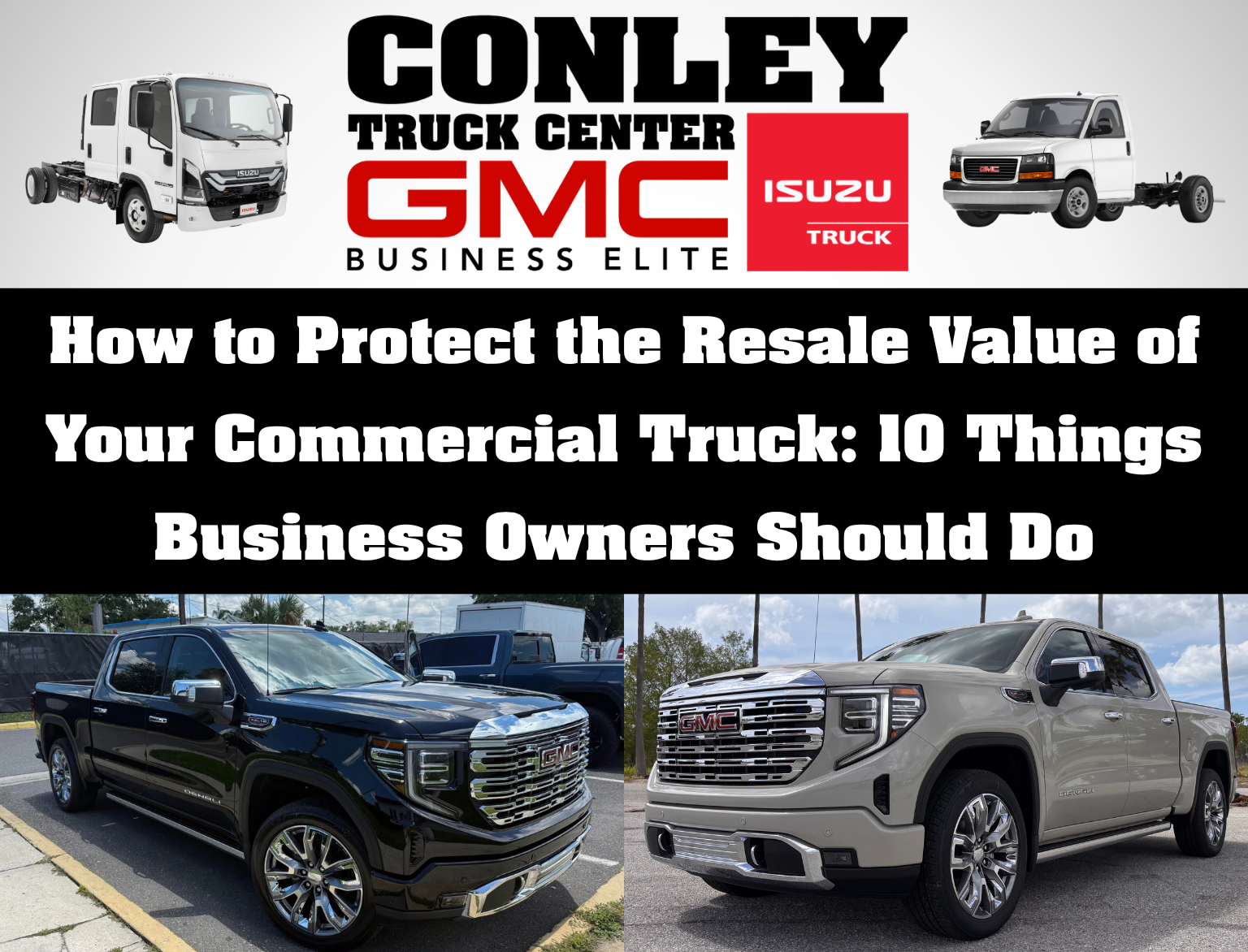
A commercial truck is supposed to make money.
But eventually, there's another number that matters:What is it worth when you're finished with it?
For businesses, resale value can easily become an afterthought.
You buy a truck.
Put it to work.
Load it with equipment.
Rack up miles.
Service it.
Modify it.
Maybe add a box, dump body, liftgate, service body or another specialized upfit.
Then, five or eight years later, you decide it's time to sell or trade it.
That's when all the decisions made during those years come back into the picture.
At Conley Truck Center in Bradenton, Florida, we don't only sell new and pre-owned commercial vehicles. We also buy trucks, including vehicles with commercial modifications and upfits.
And when it comes time to evaluate a commercial truck, mileage is only one part of the story.
If you operate one work truck or an entire fleet, here are 10 things you can do throughout ownership to help protect your investment.
1. Treat Maintenance Records Like They Have a Dollar Value
Because someday, they might.Imagine you're looking at two nearly identical used commercial trucks.
Same year.
Same model.
Similar mileage.
Similar body.
Truck A comes with a detailed maintenance history showing regular service throughout its working life.
Truck B comes with:
"We took pretty good care of it."
Which truck gives you more confidence?
Documentation matters.
Commercial vehicles work hard, and a clear maintenance history helps tell the next owner—or dealership evaluating the vehicle—how it was treated.
Keep records of things like:
- Oil and filter changes
- Brake service
- Tire replacements
- Fluid services
- Cooling-system maintenance
- Transmission service
- Repairs
- Inspections
- Recall work
- Major component replacements
That record can help with maintenance planning today and become useful documentation when it's time to sell tomorrow.
2. Don't Confuse "Still Running" With "Well Maintained"
Commercial trucks are tough.That's why businesses buy them.
But durability can occasionally encourage a dangerous attitude:
"It's still running, so we'll deal with it later."
Later has a habit of becoming expensive.
A small issue that could have been addressed during routine maintenance may develop into a larger repair.
Meanwhile, deferred maintenance can create a pattern that's visible when the truck is eventually inspected.
Maintaining a work truck isn't only about preventing breakdowns.
It's also about protecting the asset itself.
At Conley Truck Center, the service department works with commercial customers because downtime represents real lost opportunity and revenue for a business. The dealership's current site says factory-trained technicians diagnose and repair commercial vehicles and that most repairs receive a 24-hour turnaround.
Keeping up with service throughout ownership can help the truck remain productive today while protecting its condition for tomorrow.
3. Remember That Buyers Inspect the Body Too
This is where commercial vehicles are completely different from ordinary cars.With a passenger vehicle, most people think about:
Engine.
Transmission.
Interior.
Paint.
Tires.
Mileage.
With a commercial truck, there's another major component:
The thing attached behind the cab.
A box truck with a damaged box isn't simply a truck with cosmetic wear.
A dump truck with a poorly functioning hoist isn't simply an older vehicle.
A liftgate that doesn't operate correctly can affect the usefulness of the entire truck.
The same goes for:
Service bodies.
Flatbeds.
Landscape bodies.
Stake bodies.
Tool compartments.
Refrigerated bodies.
Shelving.
Cargo equipment.
Commercial buyers are purchasing a complete business tool.
That means the condition of the upfit can influence how desirable that vehicle is.
4. Take Care of the Upfit Like You Take Care of the Chassis
This deserves its own section.Imagine you've invested thousands of dollars into turning a commercial chassis into exactly the truck your business needs.
Then the upfit receives virtually no maintenance for five years.
That doesn't make much sense.
Moving components should operate properly.
Doors should close correctly.
Locks should work.
Storage compartments should remain usable.
Hydraulic systems should receive appropriate attention.
Liftgates should be inspected and maintained according to their requirements.
Rust or corrosion should be addressed.
Electrical accessories should function.
A good commercial body can add tremendous usefulness to a truck.
Maintaining that body helps preserve that usefulness.
Conley Truck Center currently works with commercial upfit manufacturers including Knapheide, Reading, Monroe, Royal, Supreme, Rockport, CM Truck Beds, Adrian Steel, Masterack, Wabash, Norstar and PJ Truck Beds, illustrating just how many different directions a commercial chassis can go depending on the business.
Your upfit is part of your investment.
Treat it that way.
5. Choose the Right Upfit in the First Place
Here's something interesting:Protecting resale value can actually begin before you buy the truck.
Some commercial configurations have extremely broad usefulness.
A box truck can appeal to:
Delivery companies.
Moving businesses.
Furniture companies.
Logistics operations.
Retail businesses.
Contractors.
Other configurations may serve much narrower applications.
That doesn't mean you should avoid a specialized upfit.
If a specialized truck makes your business substantially more productive, that's exactly what you should buy.
But businesses should understand the tradeoff.
The more specialized the truck becomes, the more specialized its potential future buyer may be.
That's another reason to work with people who understand commercial vehicles when choosing a chassis and body combination.
You're not simply building today's truck.
You're creating an asset that may eventually have another owner.
6. Don't Ignore the Cab
Work trucks get dirty.Nobody expects a five-year-old commercial vehicle to look like it spent its entire life inside a museum.
But there's a big difference between normal commercial wear and neglect.
Seats.
Dashboard.
Flooring.
Door panels.
Headliner.
Controls.
Storage areas.
Employees interact with these surfaces every day.
Small habits can make a difference over several years.
Use appropriate floor protection.
Clean spills.
Repair damaged upholstery before it gets significantly worse.
Avoid letting the cab become permanent storage for trash and unused equipment.
And periodically give the interior a real cleaning.
The cab doesn't need to be flawless.
It should look like the business cared about its equipment.
7. Don't Let Small Exterior Damage Become Big Exterior Damage
Work trucks encounter things passenger vehicles rarely do.Job sites.
Branches.
Loading docks.
Equipment.
Forklifts.
Tools.
Loose materials.
Tight parking areas.
Minor damage happens.
But ignoring damage can create additional problems.
A small exposed area of metal may eventually develop corrosion.
A damaged door or compartment can worsen.
A loose piece of body hardware can create more wear.
Again, perfection isn't realistic.
Commercial trucks are supposed to work.
The goal is simply to prevent minor issues from becoming major ones.
There's a difference between a truck that has been used and a truck that has been neglected.
Future buyers can usually see it.
8. Be Smart About Modifications
Modifications can add enormous value to a work truck.They can also make the vehicle harder to sell if they're poorly executed.
There's a difference between a professionally installed commercial upfit and improvised modifications that future owners have to undo.
Think carefully before:
Drilling unnecessary holes.
Making permanent alterations.
Changing wiring.
Adding equipment without considering the electrical system.
Welding or modifying structural components.
Removing factory equipment.
A modification should make the truck better at its job without unnecessarily compromising the underlying vehicle.
And whenever possible, keep documentation for professionally installed equipment.
Conley Truck Center specifically notes that when evaluating trucks it buys, its team considers factors including mileage, overall condition, modifications and market demand—and has experience assessing the added value of commercial upfits.
That makes professional, useful modifications very different from random alterations.
9. Mileage Matters — But So Does What Happened During Those Miles
Two commercial trucks can show 100,000 miles and have lived completely different lives.Truck A spent most of those miles cruising on highways.
Truck B spent years making dozens of short deliveries every day.
Stopping.
Starting.
Idling.
Loading.
Unloading.
Backing.
Maneuvering through job sites.
The odometers may match.
The duty cycles don't.
That's why maintenance history and overall condition are so important.
Mileage provides context.
It doesn't tell the entire story.
This is also why a higher-mileage truck with an excellent history can sometimes be more appealing than a lower-mileage truck with obvious signs of neglect.
Buyers aren't purchasing the number on the dashboard.
They're purchasing the truck attached to it.
10. Know When It's Time to Sell
This may be the hardest part.Business owners often fall into one of two camps.
The first replaces vehicles extremely early.
The second keeps them until the tow truck becomes a member of the staff.
There's a middle ground.
Every commercial vehicle has a period where it provides excellent productive value.
Eventually, maintenance expenses may increase.
Downtime may become more frequent.
Business requirements may change.
Or newer equipment may simply be better suited to the operation.
The goal isn't necessarily to squeeze every possible mile out of a truck.
It's to maximize its business value.
Sometimes selling a truck while it still has meaningful useful life can provide capital toward the next vehicle.
Waiting until it needs substantial repairs, has serious cosmetic problems and no longer performs reliably may reduce your options.
Think About Resale Before Your Business Outgrows the Truck
There's another reason companies sell commercial vehicles:The truck is perfectly fine.
The business simply changed.
Maybe you started with local deliveries and now need a larger box.
Maybe your landscaping company added another crew.
Maybe you need a crew cab.
Maybe payload requirements increased.
Maybe your business no longer performs the type of work the truck was built for.
Maybe you need to move from a lighter truck into something like an Isuzu NRR or FTR.
That's normal.
Business equipment should evolve with the business.
A truck doesn't have to be worn out to be worth replacing.
Sometimes it simply needs a different job—and another business may be looking for exactly what you have.
Why Isuzu Trucks Can Make Sense as Long-Term Business Assets
One reason commercial buyers consider Isuzu trucks is that they're designed specifically around business applications.Conley Truck Center's current Isuzu lineup includes trucks such as the NPR-HD, NPR-XD, NQR, NRR and FTR.
The site's current vehicle information highlights qualities such as maneuverability, durability and multiple vocational applications across the lineup.
The cab-over configuration also allows these chassis to be paired with a wide variety of commercial bodies.
That versatility matters throughout ownership.
A well-maintained chassis paired with a useful commercial body can remain a productive piece of equipment for a long time.
And when you're finished with it, another company may be able to put that same configuration to work.
A Good Example: The Landscape Dump Truck
Consider a landscape truck.Conley Truck Center currently offers Isuzu chassis equipped with specialized landscape dump bodies designed for landscaping, construction and municipal applications.
One current NPR-HD configuration uses a 14-foot aluminum landscape dump body with features including tool storage, side-loading capability, a tarp system and dedicated shovel storage.
That's much more than transportation.
It's a specialized business tool.
If properly maintained, the useful value of that vehicle extends beyond the engine and chassis.
Another landscaper or contractor may specifically want those features.
That's why commercial truck resale is different from selling an ordinary used vehicle.
The right upfit can matter.
Crew Cab Trucks Can Have Another Advantage
Crew cab commercial trucks are another interesting example.Conley currently lists an Isuzu NRR Gas Crew Cab capable of seating up to seven people and supporting several vocational configurations.
Think about who might find that useful.
Landscaping companies.
Construction crews.
Municipalities.
Service companies.
Businesses that need to move employees and equipment together.
When it's time to sell, you're not simply offering "a used truck."
You're potentially offering another company a ready-made solution to a specific operational problem.
That's why maintaining both the vehicle and its equipment matters.
Should You Remove Your Company's Branding Before Selling?
Usually, yes.Commercial trucks often become moving billboards.
Company logos.
Phone numbers.
Websites.
DOT information.
Unit numbers.
Wraps.
Lettering.
Before selling or trading a truck, remove business-specific branding appropriately.
This isn't only about appearance.
You probably don't want a vehicle carrying your company's name after it belongs to somebody else.
If the truck has been fully wrapped, professional removal is generally preferable to aggressively attacking the vinyl yourself and potentially damaging the finish underneath.
Planning ahead matters here, too.
A well-installed and properly maintained wrap may have protected portions of the paint during ownership.
But removal should be handled carefully.
Clean the Truck Before You Have It Evaluated
This sounds almost too obvious.But commercial vehicles are busy.
Sometimes owners bring them in exactly as they finished Friday's job.
Tools everywhere.
Trash inside.
Materials in the body.
Mud.
Debris.
Receipts from 2023.
Give the truck a chance to present itself properly.
Wash it.
Clean the cab.
Empty unnecessary equipment.
Organize whatever stays.
Make sure the body is accessible for inspection.
Gather service records.
Find spare keys.
Bring documentation for significant upfits or equipment if available.
You're trying to make the evaluator's job easier.
That's rarely a bad strategy.
Should You Repair Everything Before Selling?
Not necessarily.This is where people can waste money.
Suppose a truck needs $5,000 worth of work.
Will spending that $5,000 increase its sale value by more than $5,000?
Maybe.
Maybe not.
Minor inexpensive fixes can make sense.
A missing piece of trim.
A burned-out bulb.
A simple maintenance item.
An easily repaired latch.
But major repairs deserve a more careful calculation.
Before putting substantial money into a truck you're planning to sell anyway, find out what it's worth in its current condition.
The numbers may surprise you.
Selling a Commercial Truck Is Different From Selling a Car
Selling a personal vehicle privately is relatively straightforward.Commercial trucks introduce additional variables.
Body configuration.
GVWR.
Wheelbase.
Equipment.
Upfit manufacturer.
Liftgate.
Cab configuration.
Commercial use.
Specialized accessories.
Maintenance history.
Business buyers may ask questions that ordinary used-car shoppers never would.
That's one reason working with a commercial truck dealership can simplify the process.
The people evaluating the vehicle understand what they're looking at.
Conley Truck Center Buys Trucks, Too
At Conley Truck Center in Bradenton, Florida, we're always interested in commercial trucks.Conley's truck-buying program accepts vehicles across makes, models and mileage ranges, whether you're trading toward another vehicle or simply looking to sell.
Our team evaluates factors including:
- Mileage
- Overall condition
- Modifications
- Upfits
- Market demand
A specialized commercial truck shouldn't necessarily be evaluated like an ordinary pickup.
The equipment attached to it may have real business value.
Sell One Truck and Upgrade to the Next
Selling a commercial truck can also become part of a larger fleet strategy.Maybe you're moving from a standard cab to a crew cab.
Maybe you need more GVWR.
Maybe you're replacing an aging box truck.
Maybe you're switching from a pickup-and-trailer combination to a dedicated landscape truck.
Maybe you're adding an Isuzu NPR-HD, NPR-XD, NQR, NRR or FTR.
Maybe your company needs a GMC commercial vehicle instead.
Selling or trading existing equipment can help offset the cost of putting the next truck to work.
And that's ultimately what matters.
Commercial vehicles aren't trophies.
They're tools.
The objective is to have the right tool earning money for the business.
Maintain Today With Tomorrow in Mind
You don't need to baby a commercial truck.That's not what it was built for.
Put it to work.
Haul with it.
Deliver with it.
Build with it.
Landscape with it.
Use it to make your business money.
But take care of it while you do.
Maintain the chassis.
Maintain the body.
Keep records.
Fix problems before they become larger.
Use quality parts.
Be thoughtful about modifications.
And periodically evaluate whether the vehicle still fits your operation.
Do those things and you're not only helping the truck perform better today.
You're protecting the asset you'll eventually sell tomorrow.
Buy, Service and Sell Commercial Trucks at Conley Truck Center in Bradenton, FL
Located at 704 Cortez Road West in Bradenton, Florida, Conley Truck Center supports businesses throughout the entire commercial vehicle ownership cycle.We offer:
- New Isuzu commercial trucks
- GMC commercial vehicles
- Pre-owned work trucks
- Work-ready trucks
- Commercial upfits
- Fleet maintenance
- Isuzu and GMC parts
- Mobile fleet service
- Commercial truck purchasing and trade-ins
Whether you're purchasing your first work truck, maintaining an existing fleet or deciding it's finally time to sell one, think about the entire life of the vehicle.
Because the best commercial truck doesn't only make money while you own it.
A well-maintained one can still return value to your business on the day you let it go.