Running a business in Florida comes with a unique set of challenges.
Heat. Humidity. Heavy rain. Stop-and-go traffic. Long stretches of highway. Tight residential neighborhoods. Busy construction sites. And depending on your industry, a truck that may spend five or six days every week hauling thousands of pounds of equipment, materials or cargo.
For a personal vehicle, these conditions might be inconvenient.
For a commercial vehicle, they're part of the job description.
That's why businesses in Bradenton, Sarasota, Tampa and throughout Florida's Gulf Coast should think carefully about how and where a commercial truck will actually be used before adding it to the fleet.
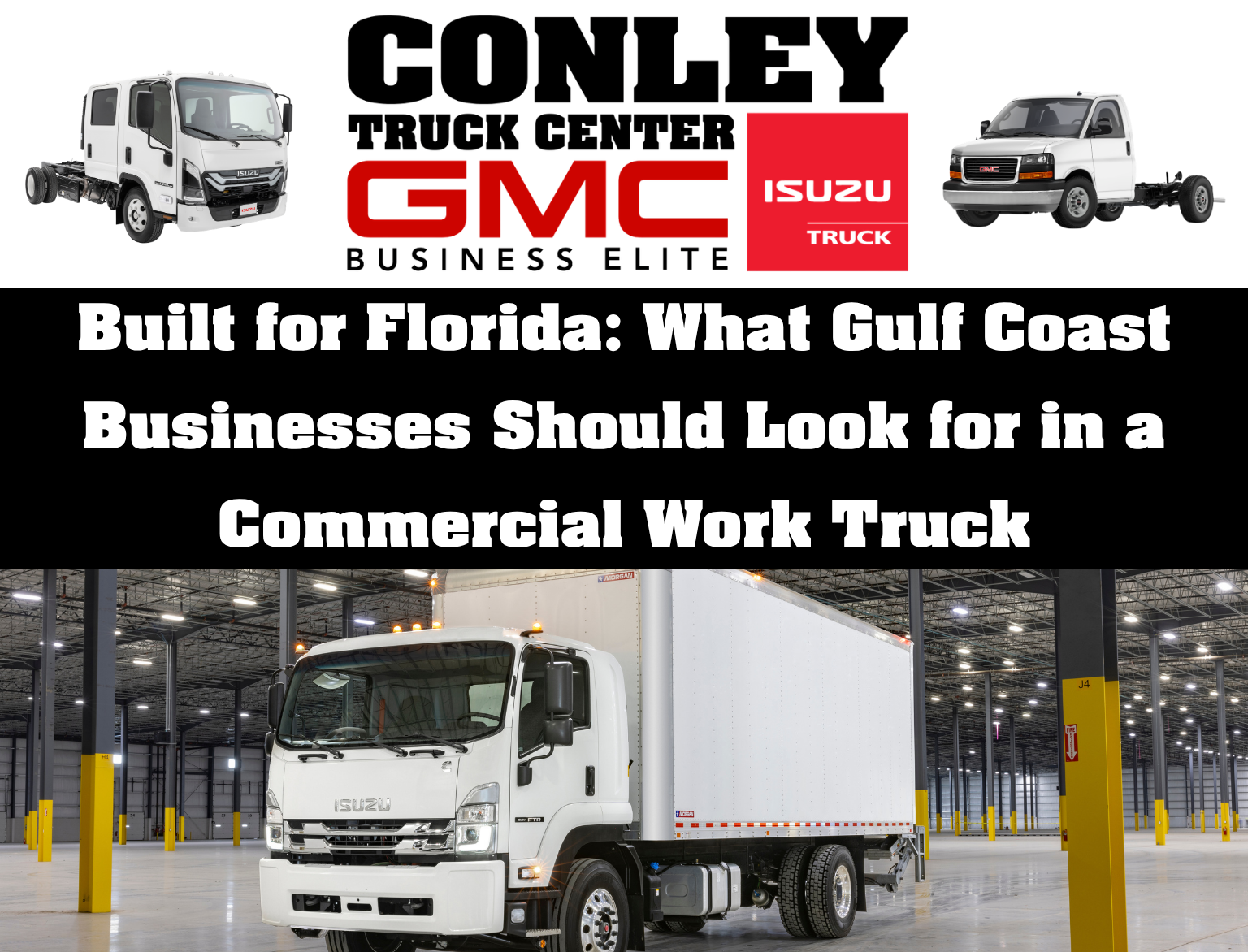
At Conley Truck Center in Bradenton, FL, we specialize in commercial vehicles for businesses that need more than basic transportation. From Isuzu cab-over trucks and GMC commercial vehicles to box trucks, landscape dumps, service bodies, cargo vans and other work-ready configurations, the right truck can become one of the most valuable tools a Florida business owns.
Here's what businesses should consider.
Florida Heat Isn't Just Hard on People
Anyone who has spent an August afternoon working outside in Bradenton knows Florida heat is serious.
Your commercial truck knows it, too.
Unlike many personal vehicles, commercial trucks may spend hours operating every day. Some run delivery routes with constant stopping and starting. Others idle at job sites. Landscaping and construction trucks may carry significant loads while operating in intense heat.
That makes proper maintenance especially important.
Cooling systems, fluids, batteries, belts, hoses, tires and other components all deserve attention when a truck operates in demanding conditions.
The lesson for business owners is simple:
Maintenance isn't something to think about after buying a commercial truck. It should be part of the purchasing strategy from day one.
A great work truck with poor maintenance can quickly become an expensive problem.
A properly maintained commercial vehicle can remain a productive business asset for years.
Rain Changes Everything
Florida doesn't exactly ease into a rainstorm.
One minute the sun is shining.
The next minute you're wondering if someone tipped the Gulf of Mexico over on top of I-75.
Heavy rain can create difficult conditions for commercial drivers, particularly when they're operating larger vehicles carrying significant loads.
Visibility matters.
Tire condition matters.
Braking performance matters.
And perhaps most importantly, drivers need to understand how their particular truck responds when loaded.
A commercial truck carrying thousands of pounds of equipment or cargo doesn't necessarily behave like an empty truck.
Businesses should account for these conditions when selecting vehicles, training drivers and establishing maintenance schedules.
Your Truck Needs to Fit the Places You Actually Work
Bigger isn't automatically better.
Florida businesses operate in an enormous variety of environments.
A landscaping company might spend the morning inside a tight residential community before driving to a large commercial property.
A delivery company may need to navigate loading areas behind restaurants and retail centers.
An HVAC contractor might work in neighborhoods where parking space is limited.
A logistics company may spend most of its time traveling between warehouses.
That's why maneuverability can be just as important as capacity.
One of the defining characteristics of Isuzu commercial trucks is their low-cab-forward design.
Instead of placing a long hood in front of the driver, the cab sits over the engine area. This creates a compact overall design while still allowing the chassis behind the cab to accommodate substantial commercial bodies.
The result is a truck designed to provide commercial capability while remaining maneuverable.
For businesses making frequent stops throughout Bradenton, Sarasota and other developed areas along Florida's Gulf Coast, that can be a major advantage.
Don't Buy a Truck. Buy an Application.
This might be the most important advice for anyone purchasing a commercial vehicle.
Don't start by asking:
"What truck should I buy?"
Start with:
"What does my business need this truck to do?"
Those are very different questions.
Consider a landscaping company.
The business might need to transport:
- Crew members
- Mowers
- Trimmers
- Blowers
- Mulch
- Sod
- Branches
- Yard debris
- Hand tools
- Fuel and equipment
Suddenly, you're not simply shopping for a truck.
You're designing a mobile landscaping operation.
A landscape dump body may dramatically improve that company's productivity.
Now consider an HVAC company.
Its priorities are completely different.
That business might benefit more from organized compartments for tools, parts and equipment. A service body or utility van could be far more valuable than an open cargo configuration.
Delivery companies might prioritize box size.
Construction companies may prioritize payload.
Municipal operations might require dump bodies.
Food distributors may need refrigerated bodies.
The application should determine the truck—not the other way around.
Why Isuzu Trucks Work So Well for Commercial Applications
One reason Isuzu trucks are found in so many industries is the versatility of the chassis.
The Isuzu lineup available through Conley Truck Center includes commercial platforms such as the NPR-HD, NPR-XD, NQR, NRR and FTR.
Rather than forcing every business into one configuration, these trucks can support a wide range of commercial bodies and applications.
Depending on the model and configuration, an Isuzu chassis can become a:
- Box truck
- Landscape dump
- Stake body
- Flatbed
- Refrigerated truck
- Contractor truck
- Delivery truck
- Equipment truck
- Specialty commercial vehicle
That flexibility allows businesses to match the truck more closely to the work being performed.
And that matters because the body behind the cab is where the truck starts making money.
Payload Is One Number Florida Businesses Should Never Guess
It's easy to look at a truck and assume it can handle a particular job.
Commercial trucks don't work that way.
Every component added to a chassis contributes weight.
The body weighs something.
A liftgate weighs something.
Shelving weighs something.
Tools weigh something.
Equipment weighs something.
Cargo obviously weighs something.
Passengers count, too.
That's why payload and GVWR should be considered before choosing a commercial vehicle or upfit.
For example, a business carrying lightweight packages has very different requirements from a company hauling dense landscaping materials, construction equipment or machinery.
The goal isn't to purchase the truck with the biggest numbers.
The goal is to select a truck with the right numbers.
That's one reason the Isuzu lineup spans multiple commercial classes and GVWR ranges.
Businesses can choose a chassis that better matches the demands of their particular operation rather than trying to make one truck fit every possible application.
Think About Tomorrow's Business, Too
There's another mistake growing companies sometimes make:
Buying exclusively for today's workload.
Imagine your business currently makes eight deliveries per day.
A particular truck handles eight perfectly.
Great.
But what happens if the company grows to twelve deliveries?
Or sixteen?
What if you land a major commercial contract?
What if you add another crew?
What if you expand from Bradenton into Sarasota, Venice or Tampa?
Suddenly, the truck that perfectly matched the business twelve months ago may be limiting it today.
That doesn't mean every company should dramatically oversize its vehicles.
It means future growth deserves a seat at the table when choosing a commercial truck.
Sometimes slightly more capacity today creates significantly more flexibility tomorrow.
Crew Cab or Regular Cab?
This is another seemingly simple decision that can have a major operational impact.
How many people actually travel to the job site?
If the answer is one or two, a regular cab may make perfect sense.
If the business regularly sends an entire crew, things change.
Certain Isuzu NPR-HD configurations are available with crew cabs that provide seating for up to seven people.
For the right business, that can eliminate the need to send an additional vehicle simply to transport employees.
Consider what that potentially means over the course of a year:
Less fuel.
Less mileage.
Less vehicle maintenance.
Fewer vehicles traveling to the same job.
Simpler crew coordination.
One configuration decision can affect the entire operation.
Gas or Diesel?
There isn't one universal answer.
That's exactly why businesses should consider their specific application.
Driving patterns, annual mileage, vehicle weight, operating environment, maintenance expectations and long-term ownership plans can all influence the decision.
Isuzu offers commercial trucks with gas and diesel powertrain options across portions of its lineup, giving businesses more flexibility when selecting the right truck.
A company making relatively short local trips may evaluate its needs differently than a fleet putting substantial highway mileage on its trucks.
Instead of automatically choosing one fuel type, businesses should examine the total operating picture.
Florida Businesses Should Think About Uptime
Every business owner understands payroll.
Every business owner understands rent.
Every business owner understands fuel.
But one of the largest hidden expenses in a commercial fleet can be downtime.
Imagine a landscaping truck that goes down during peak season.
The employees are still there.
The jobs are still scheduled.
The customers are still waiting.
But the equipment required to perform the work isn't available.
That's why the dealership behind the commercial vehicle matters.
Conley Truck Center isn't simply a place to purchase trucks.
Our Bradenton location provides dedicated commercial vehicle service and parts support designed to help businesses keep their trucks working.
For Isuzu owners, our service operation includes trained technicians capable of handling everything from routine maintenance to more complex commercial truck repairs.
We also source and stock genuine Isuzu parts to help customers maintain their vehicles with components designed specifically for their trucks.
What If the Truck Can't Come to the Shop?
There's an interesting problem with commercial vehicle service:
Sometimes getting the truck to the dealership is part of the problem.
Businesses may have multiple vehicles that need routine maintenance. Removing them from their normal operating location takes time and coordination.
That's one reason Conley Isuzu Truck Center offers mobile truck service.
For qualifying maintenance and repair needs, commercial service can come directly to the customer.
For fleet operators, that changes the maintenance equation.
Instead of thinking only about:
"When can we get the truck to the shop?"
The conversation can become:
"Can the shop come to the truck?"
For a business where every hour of uptime matters, convenience like that can have real operational value.
Sometimes the Smartest Florida Work Truck Is Used
Not every business needs a brand-new commercial truck.
In fact, a quality pre-owned truck can make tremendous financial sense.
Used commercial vehicles may allow businesses to acquire more capability for their budget while avoiding some of the initial depreciation associated with purchasing new.
There's another advantage that's particularly important in the commercial world:
The truck may already be upfitted.
Finding a pre-owned Isuzu with the right box, dump body or other commercial equipment can potentially eliminate the time and expense involved in starting with a bare chassis and building the vehicle afterward.
Conley Truck Center maintains an extensive selection of pre-owned commercial vehicles, with a particularly strong inventory of used Isuzu trucks.
For businesses expanding fleets, replacing older equipment or starting a new company, pre-owned inventory can open up options that might otherwise be outside the budget.
Inspect the Body, Not Just the Cab
When evaluating a used commercial truck, mileage is important.
But it's not the only thing worth inspecting.
Remember what these vehicles are designed to do.
Work.
That means the commercial body deserves attention.
For a box truck, examine the box itself.
For a landscape dump, consider the condition and operation of the dump equipment.
For a truck with a liftgate, the liftgate matters.
For a service body, inspect compartments, doors and hardware.
Commercial buyers should evaluate the vehicle as a complete working system—not simply a chassis with something attached to the back.
The Right Truck Can Make Florida Business Easier
Florida will always be Florida.
It's going to be hot.
It's going to rain.
Traffic will occasionally test everyone's patience.
Job sites won't suddenly become easier to access.
And businesses will continue expecting their equipment to work when it's needed.
You can't control those things.
But you can control the equipment you bring to the job.
The right commercial truck can provide the payload your business needs.
The right body can make employees more productive.
The right chassis can make difficult locations easier to navigate.
The right maintenance strategy can reduce unexpected downtime.
And the right commercial truck partner can help you keep that vehicle working long after it leaves the dealership.
Find Your Next Work Truck at Conley Truck Center in Bradenton, FL
Located at 704 Cortez Road West in Bradenton, Florida, Conley Truck Center serves businesses throughout Bradenton, Sarasota, Lakewood Ranch, Venice, North Port, Tampa, Fort Myers and communities across the state.
We offer a wide range of new Isuzu commercial trucks, GMC commercial vehicles, pre-owned work trucks and work-ready commercial configurations, along with dedicated service, mobile service and genuine commercial truck parts.
Whether you operate one truck or an entire fleet, our goal is simple:
Help you find the vehicle that makes the most sense for your business.
Because in Florida, your work truck doesn't need to simply survive the workday.
It needs to help you make the most of it.
Conley Truck Center — commercial trucks built for businesses that have work to do.